

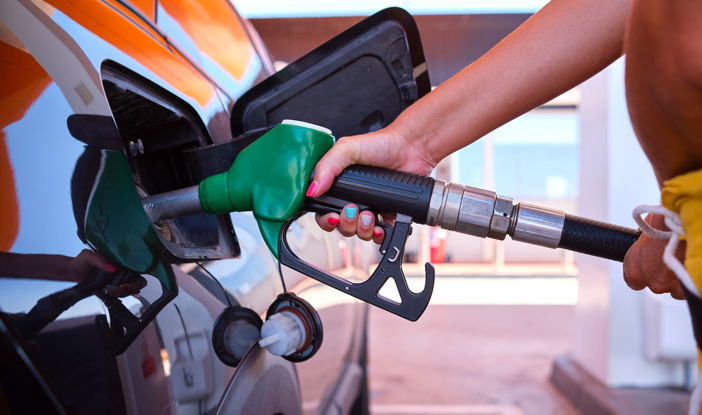
Quick Summary: How to Save Money on Gas
- Compare gas prices using apps to find the cheapest fuel near you
- Drive at steady speeds and avoid aggressive acceleration
- Reduce vehicle weight and avoid roof storage to improve fuel efficiency
- Keep your car well-maintained, including tire pressure and engine care
- Limit unnecessary driving by combining trips or walking when possible
Driving can be expensive, especially with the recent spike in fuel prices. As of March 31, 2026, the average U.S. price for a gallon of gas topped $4 per gallon, the first time since 2022, according to AAA. To help you weather this budget hit, here are simple, proven ways to improve your gas mileage and save money on fuel. These 12 gas-saving tips will help you spend less at the pump and drive more efficiently.
1. Find the cheapest gas prices near you.
Before filling up, use apps like GasBuddy to find the lowest gas prices nearby. Even small price differences per gallon can add up over time. One simple tip is to compare prices near your home and workplace and plan your fill-ups accordingly. You might find a significant price difference between the two locations.
Be mindful when you fill up. According to GasBuddy, prices are consistently lowest on Sunday and Monday in most states. Midweek, Wednesday through Saturday, is usually the most expensive, as gas stations often raise prices ahead of the weekend when more people are driving.* Speaking of weekends, holiday weekends also cause prices to increase, so if you can, avoid filling up just before or during a long holiday weekend.
2. Avoid warming up your car for too long.
Modern vehicles don’t need long warm-ups. According to AAA, if your car was built after 1980, you only need to warm it up for a few seconds before driving away.** This helps reduce fuel waste, improve efficiency, and extend engine life.
3. Drive at fuel-efficient speeds.
According to the U.S. Department of Energy, driving aggressively, such as speeding, rapid acceleration, and braking, wastes gas. It can lower gas mileage by roughly 15% to 30% at highway speeds and 10% to 40% in stop-and-go traffic.*** Not only will driving sensibly save you money, but it’s also safer for you and everyone around you on the road.
4. Consider an electric or hybrid vehicle.
If you’re in the market for a new car, investigate electric vehicles (EVs) or plug-in hybrids. These vehicles can cost up to 50% less to operate than gas-powered cars. Many also qualify for tax credits and incentives. According to the U.S Department of the Treasury, you could save $1,750 annually on average for fuel and maintenance costs, or $21,000 of discounted savings on an electric vehicle over the typical 15-year lifespan of a vehicle compared to a comparable gasoline vehicle.†
If an electric, hybrid, or fuel-efficient vehicle is in your future, we have a way to save you money. Our auto loan rates are as low as 4.99% APR†† with Direct Deposit and Auto Pay. This low rate applies to both new and used vehicles. And if you already have an auto loan, consider refinancing with us. We offer refinance rates as low as 4.99% APR, which could save you significantly over what you’re currently paying.
5. Reduce idling time.
Idling wastes fuel. If you’re stopped for more than 10 seconds, turn off your engine. Many newer cars have automatic stop-start technology to help with this.
Don’t be one of those people who start their car, then spend time on their phone before actually driving, wasting gas. Use your mobile phone when the engine is off, not while idling or driving; you’ll save money and stay focused on driving.
6. Remove extra weight from your car.
Carrying excess weight reduces fuel efficiency. An extra 100 pounds in your trunk can reduce your MPG by up to 2 percent.‡ Keep your vehicle light to save on gas.
7. Avoid using roof racks when not needed.
Roof racks and cargo carriers are a great way to manage your gear for road trips, but when they are not in use, take them off your vehicle. They can increase wind resistance (drag), which can reduce fuel efficiency by:
- Up to 8% in city driving
- Up to 25% on highways‡‡
Whenever possible, store items inside your vehicle.
8. Limit air conditioner usage.
Using your car’s AC can reduce fuel economy. On mild days, consider using ventilation instead (roll down your windows) or set your AC to a moderate level to reduce fuel consumption. However, if you’re traveling on highways, it’s more efficient to roll up the windows (due to drag) and use the car’s AC.
9. Combine trips and drive less.
Plan errands ahead of time and combine multiple stops into one trip. This reduces engine warm-up cycles and helps you use less gas overall. Walking or biking for short trips also saves money and improves your health. Also, consider using public transportation; a bus fare or a train/subway ticket could be far cheaper than a gallon of gas.
10. Take advantage of gas rewards programs.
Many grocery stores and gas stations offer fuel rewards programs. Earn points while shopping and redeem them for discounts at the pump. Numerous credit cards offer cash back for fuel purchases.
11. Use the recommended motor oil.
Always use the motor oil grade recommended by your vehicle manufacturer. Using the wrong oil can reduce engine efficiency and lower gas mileage.
12. Maintain your vehicle regularly.
Proper car maintenance is essential for fuel efficiency:
- Keep tires properly inflated
- Rotate tires every 5,000 miles
- Check spark plugs, brakes, and fluids
- Address check engine lights promptly
A well-maintained car uses less fuel and performs better.
Final thought: Start saving on gas today.
Saving money on gas doesn’t require major changes, just smarter habits. By following these fuel-saving tips, you can improve your gas mileage, reduce fuel costs, and make your car more efficient. Keep this list handy and start saving every time you drive.
This article is provided for educational purposes only and is not intended as financial or legal advice. Members should contact the Credit Union for guidance regarding their individual situation.
*GasBuddy.com. “GasBuddy Reveals The Best Day Of The Week To Buy Gas In 2026.” Gasbuddy.com. Published 18 February 2026. Accessed 31 March 2026.
**AAA.com. “How Long To Warm Up The Engine Before Driving.” AAA.com. Accessed 31 March 2025.
***,‡‡U.S. Department of Energy. “Driving More Efficiently.” Energy.gov. Accessed 31 March 2026
†U.S. Department of the Treasury. “U.S. Department of the Treasury Announces More Than $1 Billion In Upfront Savings for Consumers On Electric Vehicle Sales.” Home.Treasury.gov. Published 12 June 2024. Accessed 31 March 2026.
††APR=Annual Percentage Rate. Rates shown are our Preferred rates based on credit worthiness (FICO® Score), and a 1.00% APR Auto Loan discount for Direct Deposit or full Agent Net Check going into a FIGFCU Checking account (either High Yield Checking or CashBack Checking) in the amount of $1,000.00 (one thousand dollars) or more monthly and Automatic Payment/Folio Deduction as a repayment method to qualify. Rates and terms are subject to credit approval. Other rates and terms are available. Other restrictions may apply. Financing available up to 130% of the Purchase Price, including tax, license, warranties and negative equity on a trade for qualified borrowers. Financing available up to 130% of the Purchase Price for a lease buyout or refinance, excluding tax or license, which were paid at the time of purchase. The Credit Union only lends up to 100% loan-to-value (LTV) for clear title or private party purchases. Please speak with a Loan Representative for complete details and qualifying criteria. Rates and terms are subject to credit approval and are subject to change at any time and without notice. All values are determined by the Credit Union using either vehicle cost or Kelly Blue Book/NADA, whichever is lower. Other rates and terms are available.
‡U.S. Department of Energy. “Vehicle Technologies Program.” AFDC.Energy.gov. Published July 2012. Accessed 31 March 2026.